
In the previous post, Krein spaces – first steps, we introduced the basic definitions and simple examples of Krein spaces, emphasizing how a fundamental symmetry turns an indefinite inner product into a Hilbert space structure. In this post we move from isolated examples to the systematic study of the whole family of Hilbert space structures generated by a given Krein space, and we begin to explore their geometric and physical interpretation.
In the last post we introduced Krein spaces. They are natural generalizations of Hilbert spaces. A single Krein space generates a whole family of Hilbert space scalar products on one and the same vector space. In what follows we will study properties of these Hilbert spaces, examine the geometry of the family, and analyze the transitions between different members of the family. Why is this important? One motivation is explained, for instance, in the monograph Geometrophysics (in Russian) by Yu. S. Vladimirov.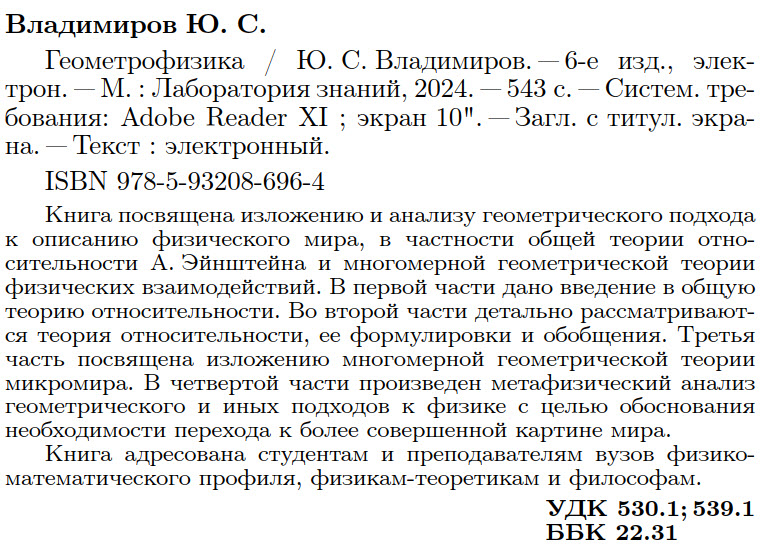
“Geometrophysics / Yu. S. Vladimirov. — 6th ed., electronic. — Moscow: Laboratory of Knowledge, 2024. — 543 pp. — System requirements: Adobe Reader XI; screen 10″. — Title from title screen. — Text: electronic.
ISBN 978-5-93208-696-4
The book is devoted to the exposition and analysis of the geometric approach to the description of the physical world, in particular Einstein’s general theory of relativity and multidimensional geometric theories of physical interactions. The first part provides an introduction to general relativity. The second part examines in detail relativity theory, its formulations, and its generalizations. The third part is devoted to the presentation of a multidimensional geometric theory of the microworld. The fourth part offers a metaphysical analysis of the geometric and other approaches to physics with the aim of substantiating the need to move toward a more advanced picture of the world.”
The book is intended for students and university instructors in physics and mathematics, as well as theoretical physicists and philosophers.
In Chapter 3, “Monad method for describing reference frames,” he examines the concept of a reference frame. He writes:
“Metaphysical analysis (see [41]) shows that any physical theory deals with elements (material entities or events) of three closely interrelated kinds: the objects (events) under consideration, the world surrounding these objects, and the reference body (system).
(…) First of all, let us clarify what an observer (reference body) is and what minimal measuring apparatus it possesses. The analysis shows that such a minimum may be taken to consist of the presence of (proper) clocks and the ability to measure the temporal components of tensor quantities, separating them from the other, spacelike components. We emphasize that the observer has these capabilities precisely at its location, i.e., along its timelike worldline.
As for other points of the manifold, the commonly used device is employed here—one assumes a continuum of observers, each of whom receives and processes information along its own worldline.”
Our “fundamental symmetries” in Krein spaces play exactly this role: they define “reference frames” of the “observer”. As we are dealing with fields “observed” by “extended observers”, each requiring a congruence of world lines, we need to set our “reference frames” in infinite-dimensional spaces, not just in spacetime of special or general relativity. In a sense, we are extending here the monad method advocated by Vladimirov to a quantum-theoretical framework.
In the previous post Krein spaces – first steps I mentioned that I will assume a basic knowledge of Hilbert spaces. In fact we will immediately need one more advanced result from functional analysis, namely the Hellinger-Toeplitz Therem (see e.g. Michael Mueger, Introduction to Functional Analysis, lecture notes 2024, p. 62) )
THEOREM (Hellinger-Toeplitz (1928))
If  are Hilbert spaces and
  are linear maps satisfying
![\[(Ax,z)=(x,Bz)\]](https://arkadiusz-jadczyk.eu/blog/wp-content/ql-cache/quicklatex.com-7a88d159b0b61049e5defd9060b4c8f8_l3.png "Rendered by QuickLaTeX.com")
for all  ,
,  , then
  and
and  are bounded.
Note: The scalar product on the left is that of  , that on the right is that of
In particular, if  and
and  , we obtain the result that any self-adjoint operator defined on the whole Hilbert space is bounded. This is how this theorem, as a corollary of the Closed Graph Theorem for Banch spaces, is stated on p. 94 in “Methods of Modern Mathematical Physicis, vol I: Functional Analysis” by M. Reed and B. Simon, Academic Press 1980.
Let us recall that a linear operator between two normed spaces is bounded if its norm, defined by
![\[ \Vert A\Vert = \sup_{\Vert x\Vert=1}\Vert Ax\Vert,\]](https://arkadiusz-jadczyk.eu/blog/wp-content/ql-cache/quicklatex.com-b30d73bed83e972c0a9050fcf03a8531_l3.png "Rendered by QuickLaTeX.com")
is finite. An equivalent condition is that there exists a constant  such that
![\[\Vert Ax\Vert\leq C\Vert x\Vert\]](https://arkadiusz-jadczyk.eu/blog/wp-content/ql-cache/quicklatex.com-75c403065756f3b191f46d043d6267bc_l3.png "Rendered by QuickLaTeX.com")
for all  Then
Then  is the smallest such constant. Moreover, is bounded if and only if it is continuous, if and only if it is continuous at
  that is if and only if
  implies
  A Hilbert space is a particular case of a Banach space, which is a particular case of a normed space., so the above applies to Hilbert space operators in particular.
Notation: Let now  be a Krein space,. We use letters
  to denote vectors in
  . Let
. Let  be the space of its fundamental symmetries – see Krein spaces – first steps. We denote by
  the Hilbert space scalar product
![\[ (x,y)_J:=<x,Jy>,\]](https://arkadiusz-jadczyk.eu/blog/wp-content/ql-cache/quicklatex.com-1e3078402f63947c9875f17ea12a3e3f_l3.png "Rendered by QuickLaTeX.com")
and by  the Hilbert space
  . We denote by
  the algebra of all bounded linear operators on . For any operator
  we denote by
  its Hermitian adjoint, defined by
![\[ (Ax,y)_J=(x,A^Jy)_J.\]](https://arkadiusz-jadczyk.eu/blog/wp-content/ql-cache/quicklatex.com-d7b2529f981d09b36860934ff2a495c5_l3.png "Rendered by QuickLaTeX.com")
Proposition 1. For any  , the operator
  is a bounded self-adjoint operator on :
![\[ (x,Jy)_J=(Jx,y)_J.\]](https://arkadiusz-jadczyk.eu/blog/wp-content/ql-cache/quicklatex.com-8bb9be805fa1ec9c2f619f730329f1c5_l3.png "Rendered by QuickLaTeX.com")
Exercise 1. Use the Hellinger-Toeplitz Theorem to prove the above Proposition 1.
Poposition 2. For any pair  the operators
  and
and  are self-adjoint on both and
  . Moreover, they are not only self-adjoint, but also positive in and in .
Exercise 2. Prove Proposition 2.
Definition. In a normed space two norms  and
and  are said to be equivalent, if there exist constants
  such that
![\[\Vert x\Vert_1\leq C_1 \Vert x\Vert_2,\text{ and } \Vert x\Vert_2\leq C_2 \Vert x\Vert_1\]](https://arkadiusz-jadczyk.eu/blog/wp-content/ql-cache/quicklatex.com-b9209dcf215a95d7b25b7976101b3dde_l3.png "Rendered by QuickLaTeX.com")
for all  . When two norms are equivalent, they define the same topology: a sequence
  converges in one norm if and inly if it converges in the other norm.
Proposition 3. For any  the Hilbert space norms for and are equivalent.
Exercise 3. Prove Proposition 3.
Corollary 1. For any , the spaces of bounded linear operators and  coincide.
Definition (of  and
and  )
)
Using the above corollary we will simply write  and use the terms “bounded” or “continuous” without specifying the particular Hilbert norm we have in mind. The adjoint of an operator
  with respect to the Krein scalar product will be denoted
  Thus
Thus
![\[ <Ax,y>=<x,A^*y>\]](https://arkadiusz-jadczyk.eu/blog/wp-content/ql-cache/quicklatex.com-18163deeaeac83f9a015f15b2b1c192f_l3.png "Rendered by QuickLaTeX.com")
and
![\[<x,Ay>=<A^*x,y>.\]](https://arkadiusz-jadczyk.eu/blog/wp-content/ql-cache/quicklatex.com-109ebd7ec414ba427e50cd9d6bbd719a_l3.png "Rendered by QuickLaTeX.com")
Exercise 4. Verify that  and
and 
Definition (the unitary group f  )
)
We denote by the group of unitary operators in  :
:
![\[\mathcal{U}(X)=\{U\in L(X): U^*=U^*U=I.\]](https://arkadiusz-jadczyk.eu/blog/wp-content/ql-cache/quicklatex.com-337f63e00ad1f640de94ee3ff971c8a6_l3.png "Rendered by QuickLaTeX.com")
Exercise 5. Show that if is in and  is in , then
  is also in .


equiveln ->
is this a new word?
I see word “Vertex” in three places.
All fixed. Thanks!